Egress gateway
The egress-gateway brokers a sandbox's outbound calls to external systems and injects a just-in-time credential for the destination. The agent never handles the credential.
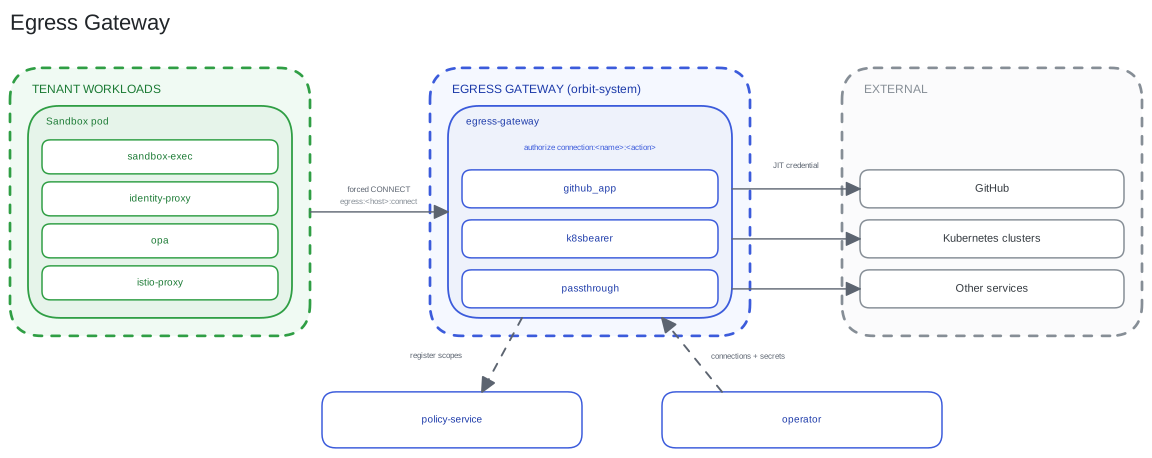
Two-layer authorization
An outbound call is authorized twice. The sandbox's opa sidecar authorizes the destination at egress:<host>:connect before the call leaves the pod, and Envoy forces it through the gateway as a CONNECT tunnel. The egress-gateway then authorizes connection:<name>:<action> against the matched tenant connection before opening it.
Credential brokering
Once authorized, the gateway mints a scoped, short-lived credential for the destination and injects it on the outbound leg: a GitHub App installation token, or a Kubernetes bearer token. It strips the platform token first. The agent never sees the injected credential, and the upstream system stays the authority on what it permits. A host with no matching connection falls through to passthrough, which injects nothing. Reachability was already gated at egress:<host>:connect.
Connections
An external system is a tenant-namespaced Connection custom resource naming an adapter, a host, and a secret. The operator aggregates every connection and its secret across tenants into a ConfigMap and Secret the gateway mounts and hot-reloads. Adapters are the credential mechanisms: github_app and k8sbearer. Passthrough is not one of them: a connection is never needed to reach a host that requires no credential, so the gateway holds that adapter itself and the registry refuses to register it. There is no database. Connections are GitOps resources.
ADRs
jit-credential-brokering-egress-gateway, connection-scope-qualifiers, credential-aware-outbound-gateway, envoy-ext-proc-sidecar-token-injection.
See also
- Connectivity for the connector call sequence.