Agent execution
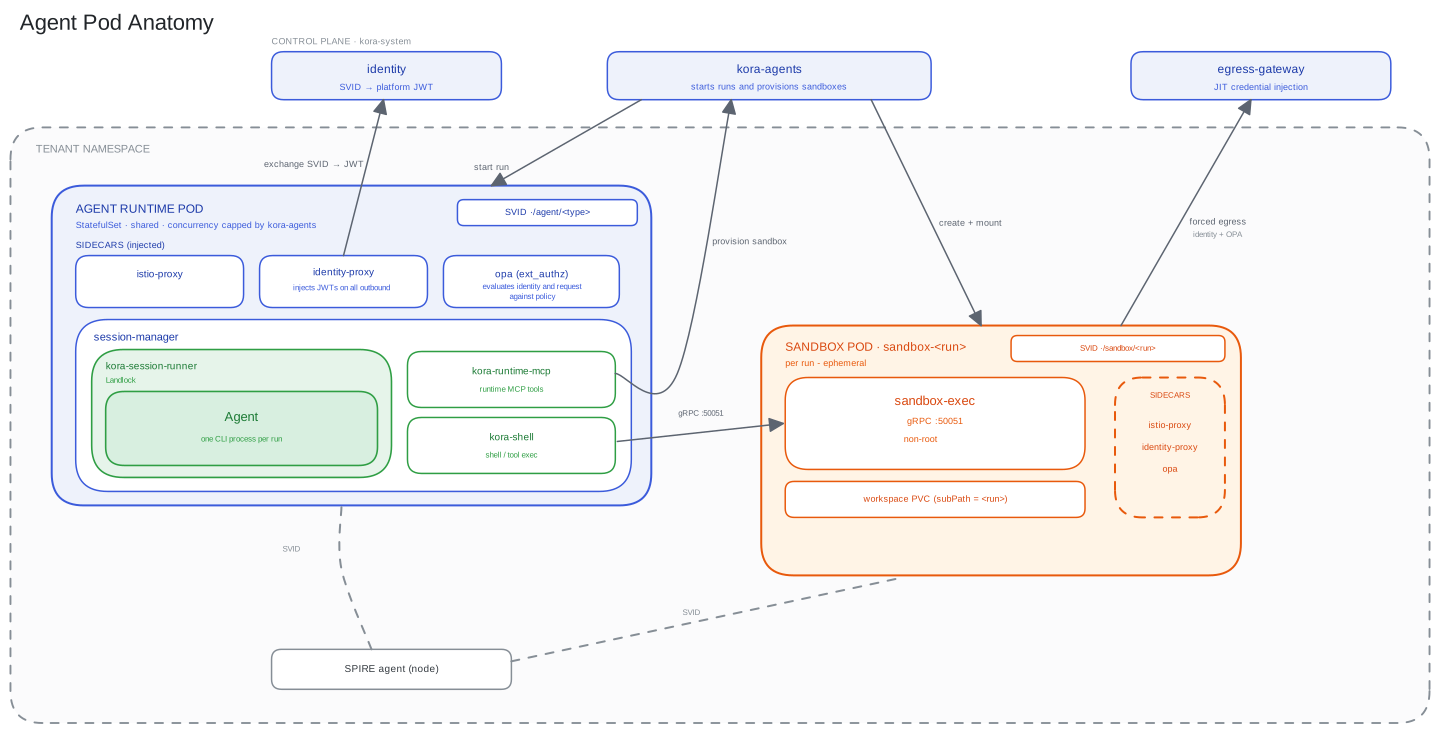
In kora, agents run as governed workloads on top of Kubernetes. Each agent process runs inside a shared runtime orchestrated by the session-manager. This session manager is responsible for the lifecycle of an agent's run. The session manager runs each agent process under landlock and provisions an isolated workspace for the agent to operate within, provisions the tools it has access to and triggers the agent startup. Every agent you create in the platform holds its own identity, these are known as agent-types, each agent-type gets its own agent pod with a running session-manager.
Agents do not have access to credentials in their session or environment. An agent's access outside of its pod is governed by the control plane: tokens are injected on egress from an agent's pod for all requests and evaluated by policy before making a network hop.
See creating an agent for configuring an agent-type's identity, behaviour and access.
Control plane and tenant workloads
Agents are run as tenant workloads within kora. A central kora-agents service within the kora-system owns the lifecycle of agent-types and their session-managers. It provisions the Kubernetes workloads into the tenant namespace and is responsible for forwarding run events to the appropriate tenant from triggers and conversations and managing the scaling of resources for agents and sandboxes.
Agent runtime pod
Each agent type gets a long-lived StatefulSet. Runs are multiplexed onto the agent-type instead of requiring a pod per agent run. This allows kora to scale agent runs at a different rate to the sandboxes those agents require for heavy workloads, reducing the idle state cost of always running agent infrastructure.
This enables agent runs that do not require a sandbox to run barebones inside their agent-type pod, requiring no further compute to complete their tasks. This is typical of agentic use cases that only utilise MCPs to complete their tasks and do not require code-ready environments for build and test like activities.
The session-manager container hosts each agent run. kora-session-runner wraps the agent harness and confines it with Landlock in its own workspace. The session-manager also hosts a local kora-runtime-mcp which provides the harness the tools required to provision sandboxes, and manage its environment. When a sandbox is provisioned, the kora-shell acts as a tool-exec shim, and ensures all tools are run inside the mounted sandbox.
| Component | Runs in | Job |
|---|---|---|
kora-agents | kora-system | Owns agent types, provisions their workloads, starts runs and provisions sandboxes |
session-manager | Agent runtime pod | Hosts every run on the pod |
kora-session-runner | Agent runtime pod | Wraps the agent harness and confines it to its workspace with Landlock |
kora-runtime-mcp | Agent runtime pod | Gives the harness the tools to provision sandboxes and manage its environment |
kora-shell | Agent runtime pod | Sends the harness's shell commands into the run's sandbox |
istio-proxy, identity-proxy, opa | Every agent runtime pod and sandbox | Intercept outbound requests, attach the platform token and evaluate policy |
Per-run sandbox
When an agent's task requires compute or tooling, it can provision a sandbox for its run. Each run can request its own isolated sandbox. The sandbox is ephemeral, and is torn down when the agent run ends, or is no longer using the idle sandbox. This allows us to provision larger compute nodes to give agents resource appropriate environments to complete their tasks effectively.
Outbound path
The kora-operator injects the Istio istio-proxy, the kora identity-proxy and an OPA ext_authz sidecar which govern all egress and the chain stamps a platform credential on all requests.
No credentials are brokered or stored in an agent's environment, session or sandbox. Every outbound request leaves the pod through its sidecar chain:
- The agent makes a bare request with no credential.
istio-proxyintercepts the request and passes it toidentity-proxy.identity-proxyattaches the agent's platform token.- The
opaext_authzsidecar evaluates the token and the request against policy, and denies it in the pod or forwards it.
Every request is evaluated in the pod before it makes a network hop to the rest of the platform.
identity-proxy obtains that token by exchanging the pod's SPIFFE SVID for a kora platform JWT with the identity service. It caches this token for the lifetime of its SPIFFE identity and automatically refreshes. The node's SPIRE agent delivers the SVID to the sidecars through the SPIFFE CSI socket. Agents that run without a sandbox can only connect to platform services, all other egress is denied.
For any external system, the agent must provision a sandbox. The sandbox's egress is forced through Envoy to the egress-gateway, which runs the same identity and policy checks and then mints and injects a just-in-time credential for the destination service.
See connectivity for a detailed walkthrough of the outbound path.